
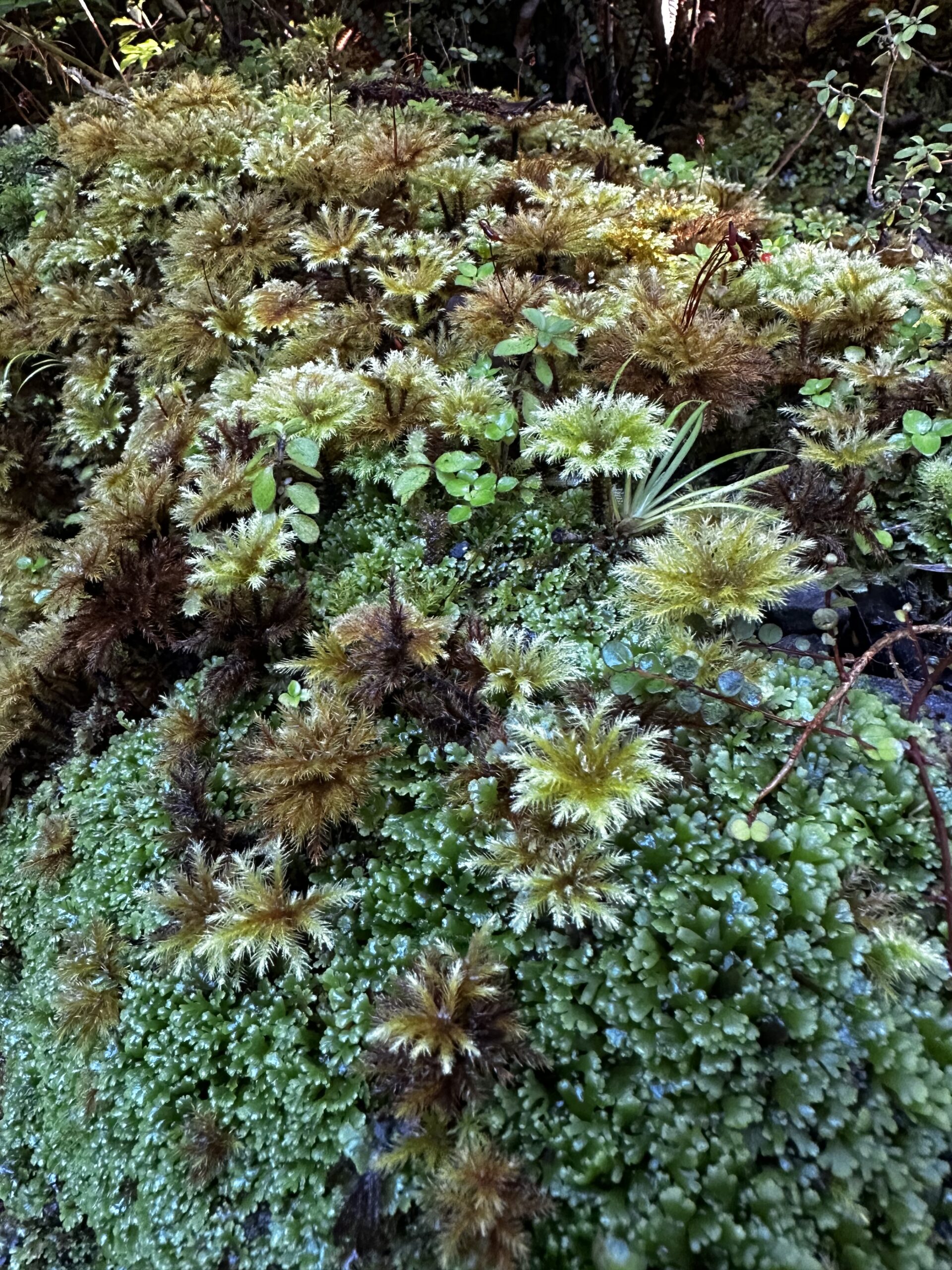
What is Regenerative Education?
Regenerative education goes beyond the typical focus on academic achievement to embrace student well-being, environmental stewardship, and community engagement. It draws on regenerative design principles — systems that restore, renew, and revitalize — to create learning environments where students grow harmoniously with nature and society.
Much of modern education was designed during the industrial era, with the accumulation of material wealth as its goal and measure of success. This system was built to produce workers, standardize knowledge, and separate learning from the living world — extracting wealth from nature rather than working in partnership with it.
Regenerative education can be described simply:
Teaching and learning that heals and restores.
It heals the disconnection many people feel from themselves, from their communities, and from the natural world. And it restores the deep relationships that allow ecosystems and societies to flourish. This approach draws from ecology, indigenous wisdom, experiential learning, and place-based education. It values both ancient knowledge and modern science, recognising that the future requires learning from many ways of knowing.
The Three Core Connections
Regenerative education begins with three fundamental relationships:
Connection with Self. A thriving world begins with individuals who understand themselves. Learners explore: Who am I? What do I care about? What are my gifts and responsibilities? When learners develop self-awareness and inner balance, they are better able to contribute to the well-being of others and the planet. Practices that support this connection include:
◦ reflection and journaling
◦ mindfulness and time in nature
◦ creative expression and purposeful work
Connection with Community. Humans are social beings — we thrive through relationships and cooperation. Regenerative education helps learners see themselves as part of something larger than the individual: building communities of belonging, learning from elders and local knowledge holders, participating in stewardship, and exploring what circular and regenerative economies look like in practice.
Connection with Nature. Perhaps the most essential connection is our relationship with the natural world. Regenerative education helps learners rediscover that we are nature — not separate from it. This learning happens through direct experience: forests, rivers, gardens, ecosystems. Nature becomes not just a topic of study but a teacher and a classroom. When learners experience this connection firsthand, caring for the Earth becomes a natural expression of gratitude and responsibility.
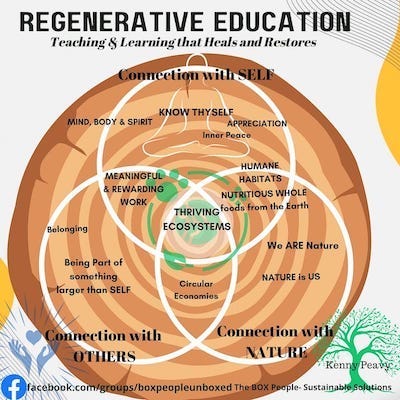
As Chief Seattle implies in his address to Washington (1854) WE ARE NATURE, NOT SEPARATE FROM IT
Man did not weave the web of life, he is merely a strand in it. Whatever he does to the web he does to himself.
Learning About, For, In, and With Nature
Regenerative education engages learners with nature in four deepening ways:
• About nature. Learning ecology, biology, environmental science, and how we are woven into the webs of ecological relationships
• For nature. Developing conservation and stewardship practices.
• In nature. Experiential learning outdoors and in real ecosystems.
• With nature. Working in partnership with natural systems — regenerative agriculture, ecosystem restoration, and nature-based design.
This final step — learning with nature — is what moves education beyond sustainability toward regeneration.
So why, despite this clarity — and despite the urgency of our ecological and social moment — does regenerative education remain at the margins of most schools?
How Economic Narratives Obstruct Regenerative Education
The impediment to regenerative education is not ignorance, lack of will, or bad leadership. It is something more structurally invisible: the economic common sense that saturates schools and the educators within them — often without anyone noticing. This is what the scholar Vanessa Andreotti calls socially sanctioned ignorance:
“Bound to the pleasures of this uneven global imaginary and its by-products (nationalism, exceptionalism, consumerism, materialism, and individualism)… the result is a modern subject who uncritically celebrates the progress and evolution that they represent, and who believes and affirms their own neutrality and innocence in the face of injustice.”
— Andreotti, The Educational Challenges of Imagining the World Differently, p.105
Schools do not merely reflect this condition. They reproduce it. While regenerative education begins with three fundamental relationships, our current education is instead shaped by three economic narratives we have come to accept as reality:[1]
Human Capital Logic. Students are first and foremost seen through an economic lens.
◦ Learning is preparation for the labour market; the economy is the primary arbiter of what constitutes a good education.
◦ Many parents evaluate educational choices by their return on investment.
◦ This narrative makes it almost impossible to justify time spent in nature, in community, or in deep reflection — because those connections do not register as “21st century skills.”
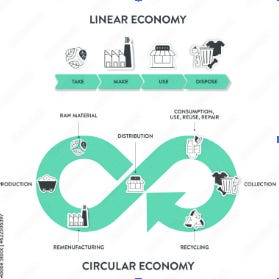
• Nature is for Extraction. Our dominant economic model is built on a linear logic: take, make, dispose. Resources are extracted from nature, processed into goods, consumed, and discarded — with no account taken of what is lost or what cannot be replaced.
◦ When resources are assumed to be inherently scarce, competition becomes the natural human condition and markets the self-evident solution.
◦ This linear logic renders the values regenerative education is built on — cooperation, reciprocity, commons-stewardship — economically unviable.
◦ Crucially, this linearity is the opposite of how nature actually works. Ecosystems are circular, regenerative, and interdependent. Our economic model treats this as irrelevant.
The Cult of Efficiency. Somewhere along the way, efficiency became education’s highest virtue. Faster, leaner, more measurable — these became the marks of a well-run school, a well-taught lesson, a well-spent life. What we rarely ask is: efficient for what? Efficient for whom?
Efficiency is not a neutral concept. It is an economic one — borrowed directly from industrial production, where the goal is to maximise output while minimising input. Applied to living systems, whether a forest or a classroom, it becomes destructive.
Forests are not efficient. Childhoods are not efficient. Relationships are not efficient. And yet these are precisely the things that make life worth living and communities worth belonging to.
Efficiency does not announce itself as as ideology. It arrives disguised as rigour, as school improvement, as accountability.
One prime example is the GDP — efficiency’s crowning achievement — the single number that tells governments, schools, and parents whether society is making progress. But GDP was never designed to measure well-being. Its own architect, Simon Kuznets, warned in his 1934 report to the US Senate that national income statistics measured productive and consumption capacity — not welfare. When schools adopt the same logic — ranking children, measuring outputs, optimising performance — they are not being rigorous. They are being economically obedient.
Regenerative education does not reject excellence. It asks a more demanding question: excellent at what? Schools that measure only what is easily counted will always miss what matters most — the child who learns to tend a garden and discovers patience, the student who sits with a community elder and learns that knowledge lives in relationship, the teenager who finds, for the first time, that learning can feel like belonging. These are not inefficiencies to be eliminated. They are the point.
The Bitter Pill: Complicity
Teachers and school leaders are not simply victims of these narratives — they are often unconscious carriers. Timetables, assessment rubrics, school marketing materials, parent expectations: all encode economic assumptions. Regenerative education, precisely because it resists reduction to utility, gets squeezed out — not by conspiracy, but by the slow accumulation of economic common sense.
Critical Economic Literacy asks us to recover epistemic sight — to see what we have been trained not to see. This is the precondition for regenerative education taking a deeper root. It requires courage, not just competence.
DISRUPT: A Thinking Routine for Epistemic Recovery
Complicity is uncomfortable. The question is what we do with that discomfort. This is where Critical Economic Literacy — and specifically the DISRUPT thinking routine — offers educators something concrete: seven lenses that make the invisible visible.
Each lens invites educators to take a second look at any issue or decision, and in particular to unmask the economic assumptions that slip into our framing of reality unannounced. To show what this looks like in practice, we apply DISRUPT to the GDP — the single metric that most powerfully shapes how progress is imagined.
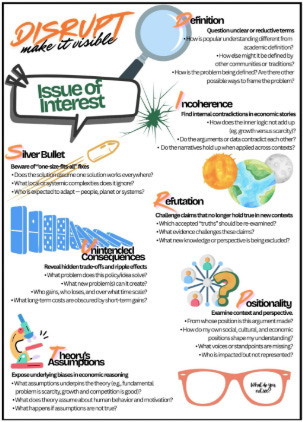
Definition. GDP was never designed to measure well-being. Its own architect, Simon Kuznets, warned in his 1934 report to the US Senate that national income statistics measured productive and consumption capacity — not welfare. The tool was a wartime accounting device, not a measure of a good society.
Incoherence. Economics teaches, as its very first lesson, that resources are scarce. Yet its crowning policy goal is infinite growth on a finite planet. The contradiction is foundational — and almost never named.
Silver Bullet. Growth is consistently offered as the solution to the very problems growth creates — inequality, ecological collapse, social fracture. No local complexity, no living system, is invited to propose a different answer.
Refutation. GDP per capita has grown enormously across the world’s wealthiest nations over the past fifty years, yet psychological distress, inequality, and ecological breakdown have deepened alongside it— not despite growth, but in many cases because of it.[2] Alternatives already exist: Doughnut Economics, Gross National Happiness, the Wellbeing Economy. It is time for the GDP to be replaced by more holistic measures.
Unintended Consequences. GDP renders invisible the debts future generations will inherit: climate breakdown, biodiversity loss, social atomisation. In schools, the same logic produces students who perform well on tests and feel little connection to the world those tests claim to prepare them for.
Positionality. GDP erases unpaid care work, ecological stewardship, and community reciprocity — the very practices that sustain living systems. The communities closest to the land are furthest from the spreadsheet.
Theory’s Assumptions. GDP assumes humans are primarily producers and consumers, nature is a resource, and what cannot be priced does not count. These are not facts. They are choices — choices schools reproduce every time they rank children by measurable output rather than by their capacity to think, care, and belong.
What This Looks Like for Educators
Over eight weeks in 2024, the first cohort of teachers completed the DISRUPT course and tracked its impact on their practice over nine months.[3] What they reported was striking.
They discovered their complicity — but this did not paralyse them. It made them feel powerful. They were not passive victims of a neoliberalised system; they could thoughtfully resist participating in it. Many reported a renewed sense of vocation: to teach for change.
This showed up concretely in their classrooms:
The design teacher reworked her sustainable chair rubric to require modularity — the chair had to be repairable, not disposable, shifting her students from linear to circular economy thinking.
The chemistry teacher began asking students to question the incessant creation of new chemical compounds and their consequences for humans, animals, and ecosystems — something she had never done before.
The art teacher had students co-create pieces with their grandparents, chronicling changes to a beloved place in nature alongside their study of Senaka’s work.
The history teacher invited students to revisit the hyperinflation of the Weimar Republic through the lens of silver bullet thinking in policy.
The economics teacher realised she had rarely shown her students counter-examples where economic theory fails — and began introducing contrarian perspectives to help them recover epistemic sight.
Regenerative education is not a distant utopia. It is a direction of travel — and many teachers are already moving in it, often without the language or theoretical backing to name what they are doing. The power of Critical Economic Literacy is that it names the obstruction clearly, so that educators can stop seeing it as an immovable wall and start seeing it as something they can DISRUPT.
This is what DISRUPT makes possible: not a curriculum overhaul, but a shift in orientation.
Teachers who see differently, teach differently. And in classrooms where that seeing happens — where a child tends soil, sits with an elder, or feels for the first time that learning is not something done to them but with nature — regenerative education has come alive.
Disclosure
The authors used Claude (Anthropic) as an editing and thinking partner in developing this article. All core arguments, analysis, and intellectual contributions are the authors’ own.
— —
[1]Andreotti, V. (2011). The educational challenges of imagining the world differently. Canadian and International Education, 40(2), 101–117.
[2]Easterlin, R. A. (1974). Does economic growth improve the human lot? Some empirical evidence. In P. A. David & M. W. Reder (Eds.), Nations and households in economic growth (pp. 89–125). Academic Press. The Easterlin Paradox describes the finding that within countries, wealthier people tend to report higher happiness; yet as countries grow wealthier over time, average happiness does not increase correspondingly.
[3]Ho, C. (2025). Recovering epistemic sight in a neoliberalized world: Critical Economic Literacy for the promotion of Critical Global Citizenship Education [Doctoral dissertation, University of Illinois Urbana-Champaign]. The five teacher cases described here are drawn from this study, conducted over nine months with secondary teachers at an international school in Beijing.
CONTACT THE AUTHORS
Dr. Catherine Ho: https://www.linkedin.com/in/cat-ho
Kenny Peavy: https://www.linkedin.com/in/kenny-peavy/